 listicle
What Happens If You Do Not Clean Gutters? UK Guide
Table of Contents
- What Happens If You Do Not Clean Gutters: The Short Answer
- The Knock-On Effects of Neglected Gutters
- Signs of Blocked Gutters You Should Not Ignore
- How Often to Clean Gutters in the UK
- Why Some Properties Need More Frequent Gutter Maintenance
- How Professional Gutter Cleaning Works
- DIY vs Professional Gutter Cleaning: What to Consider
- Keeping Gutters Clear: Maintenance Advice That Helps
- Frequently Asked Questions
Last Updated: September 15, 2026
What Happens If You Do Not Clean Gutters: The Short Answer
If you do not clean gutters, rainwater stops flowing away from your roof and instead spills over the edges, soaking walls, saturating ground next to the building and, over time, working its way into places that are expensive to fix. That is the honest short answer. This guide from Refresh Revive Exterior Cleaning explains what actually happens, why it happens and how often to clean gutters in Bolton and across Greater Manchester.
The first thing to understand is that gutters rarely fail dramatically. They fail quietly. A handful of moss, a few leaves and a bird's nest are enough to slow the flow. Water backs up, finds the weakest point and starts doing damage you may not notice for months.
Below, we'll show you exactly what to look for, how often to clean gutters, and why some properties need attention far more often than others.
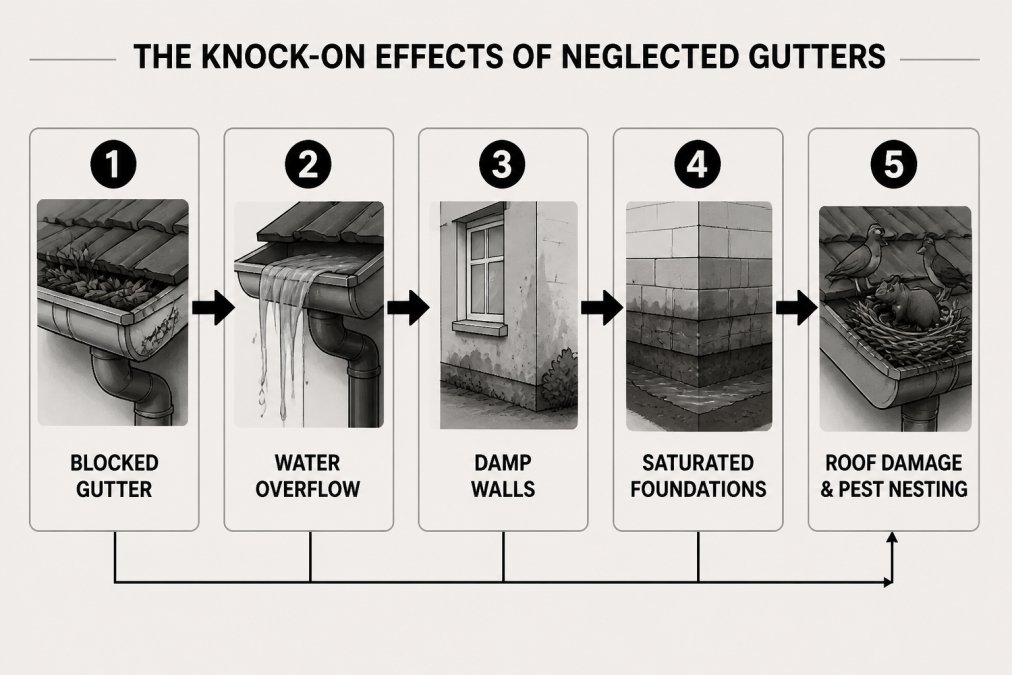
The Knock-On Effects of Neglected Gutters
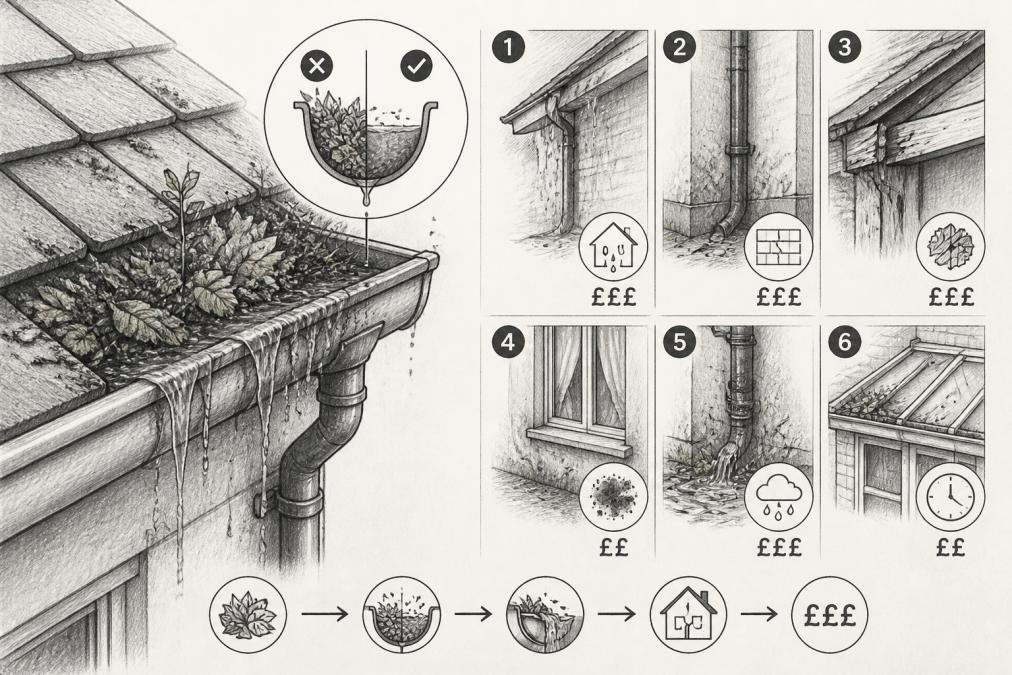
A blocked gutter causes a chain of problems that spreads well beyond the gutter itself. Water always finds a way out, and it is rarely the way you would choose.
Damp Walls and Interior Damage
Water that overflows a blocked gutter runs down the face of the building. Render, brickwork and pointing all absorb moisture over time. You may first notice a green tinge on the wall, then blown render or crumbling mortar, and eventually damp patches on an interior wall.
The Health and Safety Executive guidance on working at height is worth noting here: clearing gutters from a ladder carries real risk, which is one reason many homeowners now choose a ground-level service instead.
Foundation and Drainage Problems
Water that cannot travel through the downpipe soaks into the ground immediately next to the property. In heavy rain, that water pools against the base of the wall. Over a wet Bolton winter, this can soften ground, saturate pathways and put pressure on drainage.
Signs of Blocked Gutters You Should Not Ignore
The signs of blocked gutters are usually visible long before the damage starts. Water spilling over the front edge during rain is the most obvious. Others include:
- Plants or grass growing out of the gutter channel
- Birds flying in and out near the roofline
- Staining or green algae streaks down the render below the gutter
- Sagging or pulling away from the fascia
- Damp patches on an internal wall or ceiling
- Water dripping from a joint long after rain has stopped
If you spot two or more of these, it is worth having the gutters checked rather than waiting for the next downpour.
How Often to Clean Gutters in the UK
Most UK homes need their gutters cleared at least once a year, ideally in late autumn after the leaves have fallen. Properties surrounded by mature trees often need attention twice a year, and sometimes more.
The Met Office climate summaries for the UK show how much rain the North West receives compared with much of the country, which is one reason gutters here tend to fill faster and overflow sooner.
Why Some Properties Need More Frequent Gutter Maintenance
Two houses on the same street can need very different schedules. What matters is what surrounds the property, not how old it is.
Properties near mature trees, particularly sycamore, ash and lime, collect far more debris. North-facing roofs stay damp longer, which encourages moss growth, and that moss eventually washes into the gutter. Bungalows and dormers are often easier to clear, while three-storey townhouses in Bury or Prestwich may need specialist access equipment.
The pitch of the roof, the number of downpipes and the condition of the gutter itself all play a part. A gutter that has lost its fall will hold water even when it looks clear.
How Professional Gutter Cleaning Works
Professional gutter cleaning uses a ground-level vacuum system with carbon-fibre poles, which removes debris without anyone standing on a ladder. An inspection camera lets the operator see inside the channel and check accessible sections as they work.
Refresh Revive Exterior Cleaning uses this approach as standard. We assess the gutter, clear the debris, flush the downpipes where needed and check the accessible run with a camera. We do not claim that footage proves the gutter is structurally sound, and clearing a blockage is not the same as a repair. Where we spot a fault, we will tell you plainly.
DIY vs Professional Gutter Cleaning: What to Consider
Clearing gutters yourself is possible on a single-storey property with safe access, and it costs very little. The trade-off is risk, reach and mess.
| Factor | DIY | Professional |
|---|---|---|
| Access | Ladder required for most homes | Ground-level vacuum |
| Safety risk | Working at height | Reduced |
| Reach | Limited to lower sections | Full run on most properties |
| Downpipes | Often left blocked | Flushed and checked |
| Waste disposal | Your responsibility | Removed |
| Best for | Bungalows, light debris | Two-storey and above, heavy growth |
If your gutters are more than one storey up, or you have seen moss and plants growing in the channel, the DIY route stops being practical. The HSE advice on ladder safety is clear that working at height is a leading cause of serious injury at home.
Keeping Gutters Clear: Maintenance Advice That Helps
A short check twice a year catches most problems early. After heavy autumn rain, look up at the roofline and check for overflow. In spring, look for moss on the roof and debris in the channel.
Gutter guards and brush inserts can reduce how much large debris enters the channel, though fine material still settles and the gutter will still need occasional clearing. Keeping roof moss in check helps too, because moss is one of the main things that ends up blocking a gutter in the first place.
Frequently Asked Questions
Can blocked gutters cause damp in walls?
Yes. When gutters overflow, water runs down exterior walls and soaks into brickwork, render or pointing. Over time this moisture can travel inward, causing damp patches, peeling paint and mould inside the home. It can also damage the mortar between bricks, which may need repointing. Keeping gutters clear helps reduce the risk of water reaching the walls in the first place, though existing damp may need separate treatment.
What are the signs that my gutters need cleaning?
Common signs of blocked gutters include water pouring over the edge during rain, plants or moss growing in the gutter channel, sagging sections, stains on the fascia boards, and damp patches on exterior walls. You may also hear birds nesting or see insects gathering near the roofline. If water drips from a joint or downpipe, debris may be forcing water into gaps. An inspection camera can help identify blockages that are not visible from ground level.
How often should gutters be cleaned in the UK?
Most UK homes need their gutters cleared at least once a year, ideally in late autumn after the leaves have fallen. Properties surrounded by trees, in shaded spots or exposed to prevailing weather may need attention more often. Bungalows and homes with easy access may manage with one thorough clean annually if debris levels stay low. A local exterior cleaning company can assess your gutters and recommend a schedule that suits your property.
Can I clean my gutters from the ground?
Ground-level gutter cleaning is possible with a professional vacuum system that uses telescopic poles and an inspection camera. This avoids the risks of working at height on ladders, which the Health and Safety Executive advises against for extended tasks. DIY options include water-fed poles or gutter scoops, but these may not clear compacted debris effectively. For safety and thoroughness, a professional service is often the more practical choice.