 comparison
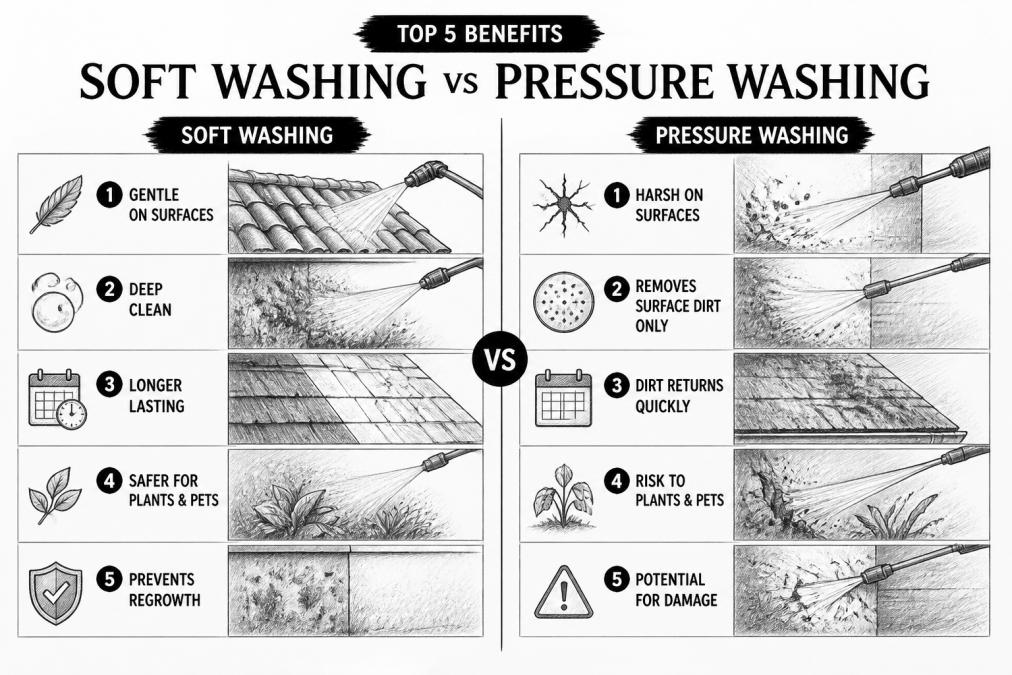
Top 5 Benefits of Soft Washing vs Pressure Washing
Table of Contents
- How Soft Washing and Pressure Washing Actually Differ
- What Soft Washing Involves
- What Pressure Washing Involves
- Five Benefits of Soft Washing vs Pressure Washing
- Render Cleaning Methods: Why Low Pressure Usually Wins
- Is Pressure Washing Safe for Block Paving?
- Soft Washing vs Pressure Washing Cost Factors
- How Refresh Revive Exterior Cleaning Chooses a Method
- Frequently Asked Questions
**
How Soft Washing and Pressure Washing Actually Differ
The top 5 benefits of soft washing vs pressure washing come down to one thing: how much force the surface can take. Soft washing is the low-pressure application of a cleaning treatment that breaks down algae, moss and lichen, while pressure washing uses controlled water pressure and flow to physically shift dirt from durable hard surfaces (hse.gov.uk). This guide from Refresh Revive Exterior Cleaning explains where each method belongs, and why the right answer is rarely "one method for everything".
In Bolton and across the North West, damp, shaded conditions encourage organic growth on render, roofs and paving. Choosing the wrong method for the material is how driveways get stripped and pointing gets loosened.
What Soft Washing Involves
Soft washing applies a suitable treatment at low pressure, letting the product do the work rather than the water.
The operator wets the surface, applies a treatment selected for the material, allows it to work, then rinses at low pressure. This approach may be more suitable for render, roofs, cladding and other surfaces that would not tolerate high pressure. It helps reduce the risk of driving water into cracks, loosening mortar or stripping protective coatings.
Soft washing is not chemical-free. Treatments are professional products that must be handled according to their labels and safety data sheets (Control of Substances Hazardous to Health (COSHH)). Regrowth is not permanent either; shade, moisture, drainage and nearby trees all affect how quickly organic growth returns.
What Pressure Washing Involves
Pressure washing uses a machine's controlled output of water pressure and flow to lift dirt, grime and organic matter from surfaces that can take it.
Pressure, flow, temperature, nozzle choice and cleaning distance all get adjusted for the material. Hot water may help break down grease and heavier organic contamination. A machine's maximum output is not the pressure reaching the surface, so the number on the side of the van tells you very little about what a surface actually receives.
On durable concrete and some paving, controlled pressure washing works well. On softer stone, older pointing or tired render, it can do more harm than good.
Five Benefits of Soft Washing vs Pressure Washing
Soft washing wins on delicate surfaces, organic growth and surrounding planting, while pressure washing wins on heavy soiling across large areas of durable paving.
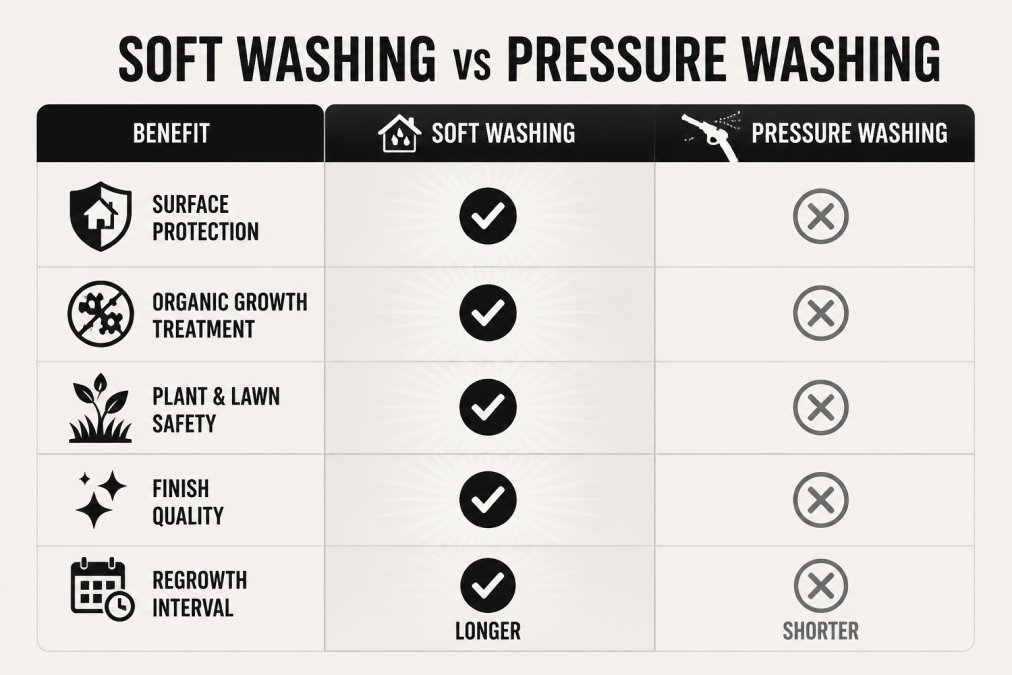
- Surface protection. Low pressure helps reduce the risk of etching, stripped pointing and lifted coatings on render and roofs.
- Treats the cause, not just the symptom. Appropriate treatments tackle algae, moss and lichen rather than only removing what is visible.
- Safer around planting and lawns. Careful control of run-off and rinsing helps protect borders, grass and neighbouring property.
- Better finish on textured surfaces. Render, roughcast and cladding clean more evenly when the treatment works into the texture.
- Longer intervals between cleans. Removing growth properly and treating the surface can extend the time before it returns, though regrowth still depends on shade, moisture and weather.
Pressure washing still earns its place. For block paving, concrete and patios with heavy soiling, controlled pressure plus the right nozzle gets results that low pressure alone would struggle to match.
Render Cleaning Methods: Why Low Pressure Usually Wins
Render cleaning methods almost always favour low pressure, because render is a coating rather than a solid slab.
Modern render systems are designed to shed water and resist staining, but they are not designed to take a jet at close range. High pressure can open hairline cracks, drive water behind the coating and leave a patchy finish that looks worse than the algae it removed (bsigroup.com). Controlled low-pressure treatment with a suitable product may be more suitable, especially on older or previously painted render.
Not every mark will lift. Some staining comes from weathering, rust runs, mineral deposits or defects in the render itself, and no cleaning method removes those. A realistic conversation before the work starts is better than a promise nobody can keep.
Is Pressure Washing Safe for Block Paving?
Pressure washing is often suitable for block paving, provided pressure, flow and nozzle choice are adjusted and the joints are treated with care.
Block paving is durable, but it is not indestructible. Too much pressure at too close a distance can blast out jointing sand, loosen blocks and leave the surface looking uneven. A sensible approach uses controlled pressure, an appropriate nozzle and a consistent cleaning distance across the whole area.
After cleaning, kiln-dried sand is usually brushed back into the joints once the paving is sufficiently dry. Re-sanding helps stabilise the blocks and slows weed growth, but it is not a permanent weed-prevention guarantee. Sealing is a separate decision and is not automatically included or suitable for every driveway.
Soft Washing vs Pressure Washing Cost Factors
Soft washing vs pressure washing cost factors come down to time, treatment, access and what has to be reinstated afterwards, not just the size of the area.
Expect the quote to reflect:
- Area size and surface type. Render, paving, stone and cladding all take different amounts of time.
- Level of contamination. Heavy moss, algae and lichen take longer than light surface grime.
- Access and working height. Roofs, upper render and awkward courtyards need more equipment and care.
- Drainage and run-off control. Protecting borders, lawns and watercourses adds time and preparation.
- Re-sanding and treatment. Kiln-dried sand, biocide treatment and any sealing are separate items.
- Condition and previous treatments. Old paint, repairs and prior DIY attempts can change the approach.
Exact figures depend on all of the above, so a quote is best given after seeing photographs and the postcode.
How Refresh Revive Exterior Cleaning Chooses a Method
Refresh Revive Exterior Cleaning assesses the surface first, chooses the right treatment, then cleans it properly.
That means looking at the material, its age, its condition, previous treatments, the type of contamination and how easy it is to access. Durable paving may be cleaned with controlled pressure washing or hot water. Render, roofs and delicate surfaces are usually treated at low pressure with a suitable product. Roofs may involve manual moss removal, debris collection, gutter clearance and professional biocide treatment where appropriate. Gutters are cleared with a ground-level vacuum and an inspection camera, and windows are cleaned with purified water through water-fed poles.
The White Glove Standard™ is the name for that approach: surface-specific methods, protection for surrounding property, planting and lawns, before and after documentation, and full insurance. Every job starts with a free, no-obligation quote.
Frequently Asked Questions
Is soft washing better than pressure washing for render?
For most render, yes. Render is a relatively soft, porous surface, and high pressure can force water behind the coating, loosen sections or leave permanent stripe marks. Soft washing applies a low-pressure treatment that breaks down algae and organic growth instead. Refresh Revive Exterior Cleaning uses controlled low-pressure render cleaning methods, but some marks caused by weathering, rust or defects may not lift completely. Every wall is assessed before a method is chosen.
Is pressure washing safe for block paving?
It can be, when it is done properly. Block paving is durable, but the jointing sand between the blocks can wash out if pressure, nozzle choice and distance are wrong. A controlled approach followed by kiln-dried sand once the surface is dry helps keep the paving stable. Re-sanding is not a permanent weed-prevention guarantee, and sealing is not automatically suitable for every driveway. Refresh Revive Exterior Cleaning adjusts the method to the age and condition of the paving.
Does soft washing remove black spots from patios?
Black spots on patios are usually lichen, and they respond better to a soft wash treatment than to water pressure alone. The treatment is applied at low pressure and left to work, then the surface is rinsed. Deeply rooted lichen on Indian sandstone or porcelain may need more than one visit. Results depend on how long the growth has been established, the porosity of the stone and how much shade the patio gets.
Is soft washing safe for plants and lawns?
Soft washing uses lower pressure than jet washing, which reduces the risk of blasting soil, gravel or mulch onto borders. Treatments are still applied carefully. Refresh Revive Exterior Cleaning covers or pre-wets nearby planting where needed, controls run-off, and follows manufacturers' labels and safety data sheets. It is worth telling us about new lawns, young shrubs or ponds before the visit so the plan can be adjusted.
When should I choose pressure washing over soft washing?
Pressure washing suits durable hard surfaces with ingrained dirt, such as concrete paths, forecourts and some natural stone. Hot water also helps with grease and organic contamination. Soft washing is usually the better option for render, roofs, painted surfaces and anything delicate. Refresh Revive Exterior Cleaning assesses the material, age, condition and access first, then selects the treatment that fits, rather than applying one method to everything.