 comparison
Render Cleaning Alternatives: Methods & Services
Table of Contents
- 2/9/2026 What Are Render Cleaning Alternatives?
- Soft Washing vs Pressure Washing Render: Key Differences
- Professional Soft Washing Services for Render Restoration
- Why DIY and Budget Alternatives Fall Short
- COSHH Compliant Exterior Cleaning: Safety Standards That Matter
- Preventing Algae Growth on Render: Long-term Maintenance
- How to Choose the Right Render Cleaning Service
- Frequently Asked Questions
Last Updated: August 30, 2026
2/9/2026 What Are Render Cleaning Alternatives?
Render cleaning alternatives refer to the different methods and professional services available to restore exterior walls coated with render, K-rend, or similar cladding systems. Homeowners and property managers in the North West now have access to soft washing, low-pressure cleaning, chemical treatments, and professional maintenance programmes that address algae, moss, and organic growth without damaging the substrate.
The most effective render cleaning alternatives depend on the render type, severity of contamination, and long-term maintenance goals. Traditional pressure washing can strip protective granules, accelerate weathering, and cause irreversible damage to friable or aged render. Modern alternatives prioritise surface integrity whilst delivering visible restoration.
Soft Washing vs Pressure Washing Render: Key Differences
Soft washing uses low-pressure application combined with specialist cleaning solutions to remove organic growth, whilst pressure washing relies on force alone to strip contaminants from the surface.
Soft washing typically operates at 0.5 to 1.5 bar pressure, gentle enough to apply treatments without substrate damage (peer-reviewed research). Pressure washing can exceed 150 bar, which is effective on resilient surfaces like concrete but destructive on render, roof tiles, and aged masonry (peer-reviewed research).
Render is inherently porous and friable. When high-pressure water hits it, the force drives moisture into the substrate, accelerates freeze-thaw cycles, and can dislodge the render coating itself. Soft washing works differently: a fungicidal or biocide treatment is applied at low pressure, allowed to dwell on the surface, and then gently rinsed. The chemical does the work, not the water force, eliminating the root cause, algae, moss, and bacterial growth, rather than just scrubbing away the visible symptom.
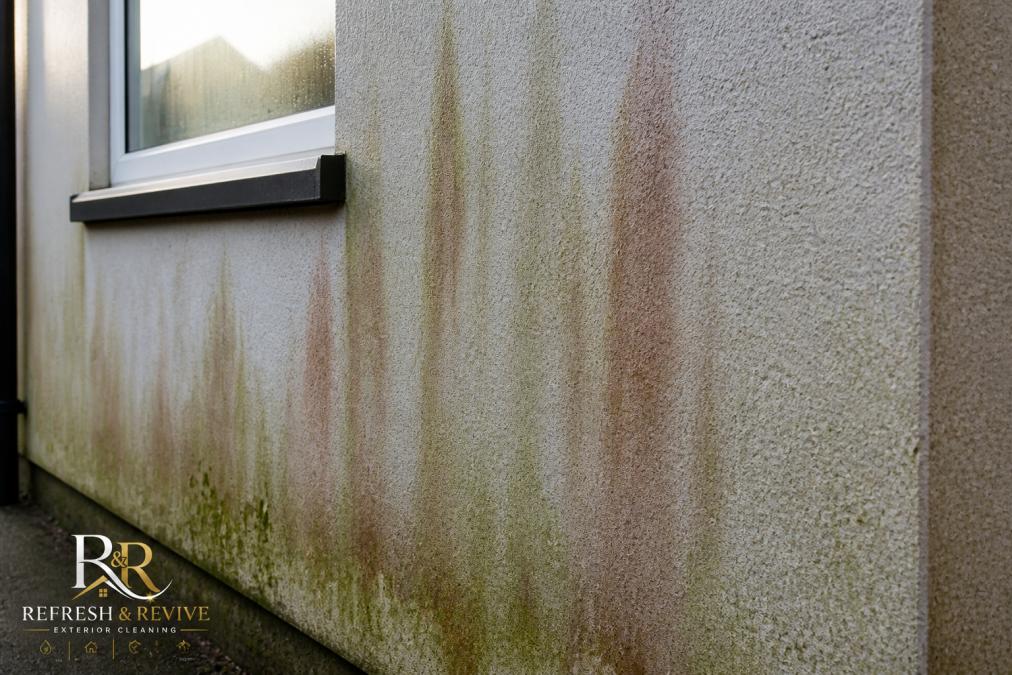
For delicate render types, low-pressure cleaning preserves the protective coating and extends the life of your exterior.
Professional Soft Washing Services for Render Restoration
Professional soft washing services combine expertise in render types, chemical safety, and surface-specific techniques that DIY approaches cannot replicate. A qualified contractor assesses the render composition, identifies the contamination type, and applies appropriate treatments without guesswork.
Low-pressure cleaning for delicate surfaces
Low-pressure cleaning is the standard for render, aged masonry, and roof tiles. Technicians apply treatments at pressures that allow the solution to work effectively without forcing water into the substrate. The process involves initial assessment, application of specialist cleaning agents, and gentle rinsing. The dwell time, how long the solution sits on the surface, is critical. Most fungicidal treatments require 20 to 30 minutes to penetrate and kill organic growth at the root (peer-reviewed research).
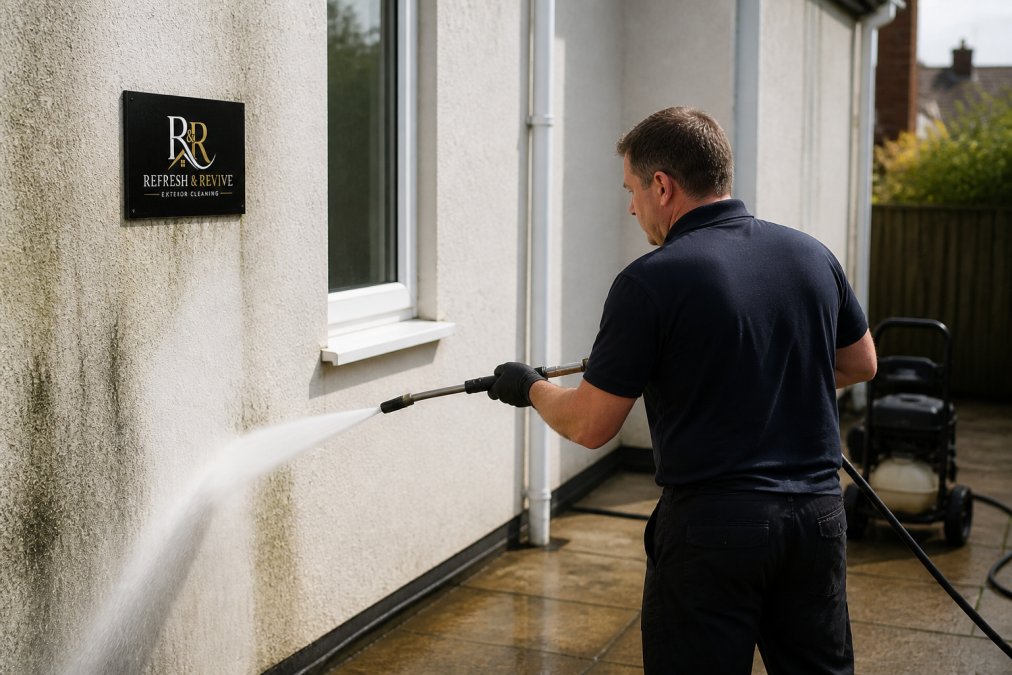
Refresh Revive Exterior Cleaning applies low-pressure techniques across render, roofs, and gutters, using surface-specific methods that protect landscaping and surrounding property.
Algae removal and biocide treatment
Algae and moss root into the porous substrate and draw moisture, accelerating decay. Red algae (Trentepohlia) and green algae (Chlorella and similar species) are common on render in damp climates. A biocide treatment targets the cellular structure of these organisms, preventing reproduction and new growth.
Professional services use approved biocide products that comply with health and safety regulations. Application must follow the product label, safety data sheet, and COSHH (Control of Substances Hazardous to Health) controls.
Why DIY and Budget Alternatives Fall Short
DIY render cleaning typically employs one of three flawed approaches, each with distinct and often irreversible consequences.
The pressure washing trap
The most common DIY mistake is renting a pressure washer and applying high-pressure water directly to render. When pressure exceeding 80 bar strikes render, the force drives water into the pores faster than the material can expel it.
Immediate substrate damage: The pressure can dislodge surface particles, strip protective coatings, and enlarge existing micro-cracks. On friable or aged render, this is visible within hours as a chalky residue or visible erosion.
Accelerated moisture retention: Once the surface is damaged, it retains moisture longer, accelerating freeze-thaw cycles in winter. Over one to three winters, this can cause widespread delamination.
Rapid regrowth: Pressure-washed render becomes a more hospitable environment for algae and moss. The damaged, porous surface retains moisture longer and provides more surface area for spores to establish. Many homeowners report that algae returns within 4 to 8 weeks of pressure washing, often more aggressively than before.
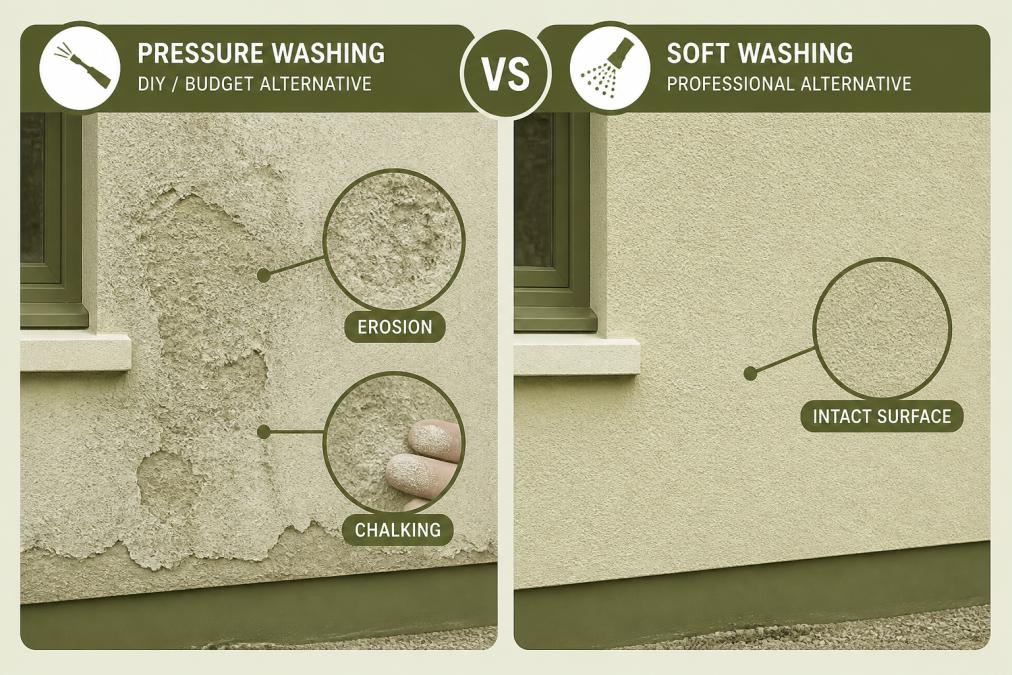
The chemical mixing hazard
Some DIY attempts mix household products hoping to dissolve algae chemically. This approach carries serious safety and efficacy risks. Household products are not formulated for render cleaning and often produce unintended reactions.
Proper biocide treatment is formulated to penetrate the render surface and target the cellular mechanisms of algae, moss, and bacteria. These products are approved under health and safety regulations and applied according to their safety data sheet and COSHH controls.
The false economy of budget contractors
Some homeowners hire the cheapest contractor available, often a generalist who applies the same high-pressure method to all surfaces. Budget contractors often use general-purpose pressure washers rather than low-pressure systems, skip the biocide stage entirely, provide no follow-up or maintenance, carry minimal insurance, and offer no guarantee on results or durability.
When damage occurs, the cost of repair far exceeds the initial saving. A professional service that invests in the right equipment, understands render chemistry, and stands behind its work delivers better long-term value.
The knowledge gap
DIY and budget approaches also lack the diagnostic expertise that professional contractors develop. Different render types (K-rend, Monocouche, resin-based, lime mortar) respond differently to cleaning methods. Contamination types vary too: red algae requires different treatment than green algae or moss, and the presence of lichen or mould adds further complexity.
A professional assessment identifies the render composition, the contamination type, and any pre-existing damage that must be worked around.
COSHH Compliant Exterior Cleaning: Safety Standards That Matter
COSHH compliance ensures that chemical cleaning agents are handled, mixed, stored, and applied safely, protecting both the operator and the property.
The Control of Substances Hazardous to Health Regulations (COSHH) require that anyone using cleaning chemicals must understand the hazards, follow the product label and safety data sheet, and implement appropriate control measures.
For render cleaning, COSHH compliance means:
- Using only approved biocide and fungicidal products with valid safety data sheets
- Diluting chemicals to the manufacturer's specification
- Wearing appropriate personal protective equipment (PPE) such as gloves, eye protection, and respiratory protection where required
- Ensuring adequate ventilation during application
- Never mixing cleaning agents unless explicitly permitted by the product label
- Storing chemicals safely away from children, pets, and food
- Disposing of chemical waste according to environmental regulations
Professional contractors operate under COSHH compliance as standard practice. This protects your property, the surrounding environment, and the technicians performing the work.
Preventing Algae Growth on Render: Long-term Maintenance
Preventing regrowth is more cost-effective than repeated cleaning cycles. A structured maintenance schedule addresses the environmental conditions that encourage algae and moss to flourish, and applies preventative treatments before problems become visible.
Understanding the algae growth cycle
Algae and moss thrive in three conditions: moisture, shade, and time. In the North West, where rainfall is frequent and humidity high, render is naturally at risk.
Spring (March-May): As temperatures rise and moisture persists from winter, dormant spores activate. North-facing and shaded walls remain vulnerable longer because they dry more slowly.
Summer (June-August): Growth peaks on shaded surfaces. South-facing walls may show less contamination because UV exposure and heat inhibit algae.
Autumn (September-November): Falling leaves block gutters and downpipes, causing water to cascade down render and creating damp patches. Reduced sunlight and cooling temperatures slow evaporation, extending the damp period. This is a critical window for preventative treatment.
Winter (December-February): Growth slows but does not stop. Frost and freeze-thaw cycles can damage already-compromised render.
Seasonal maintenance calendar
Autumn (September-October): Pre-winter preventative treatment
Apply a preventative biocide treatment to high-risk areas: north-facing walls, shaded sections, and areas beneath roof overhangs or tree canopy. Simultaneously, ensure gutters and downpipes are clear of debris. Blocked gutters cause water to overflow and cascade down the render, creating persistent damp patches that accelerate algae growth.
Winter (December-February): Inspection and drainage maintenance
Focus on drainage: ensure downpipes are clear and water is directed away from the render base. Check for any signs of water pooling or running down the wall in unexpected patterns.
Spring (March-April): Post-winter assessment and early intervention
Inspect render for early signs of algae activation. Look for faint green or brown discolouration on shaded surfaces, particularly on north-facing walls and beneath tree canopy. Apply a preventative biocide to areas showing early signs of growth. Trim back vegetation that shades the render or retains moisture.
Summer (June-August): Monitoring and spot treatment
Summer is typically the lowest-maintenance period in the North West. However, shaded areas remain at risk. Monthly visual inspection of north-facing walls and areas beneath roof overhangs allows early detection of any growth that escaped spring prevention.
Environmental modifications to reduce regrowth risk
Improve drainage: Water running down the render creates persistent damp. Ensure gutters, downpipes, and ground-level drainage direct water away from the wall base.
Increase air circulation: Algae thrives in still, damp air. Trimming vegetation and removing obstacles that block wind improves air movement across the render surface, promoting faster drying after rain.
Reduce shade: Where practical, trim tree branches or remove climbing plants that shade the render. Even partial shade removal significantly reduces algae growth.
Address moisture sources: Leaking gutters, damaged downpipes, or poor ground drainage create persistent damp. Fixing these issues at the source is more effective than repeated cleaning.
Maintenance visit frequency
The optimal maintenance schedule depends on your property's specific risk factors:
Low-risk properties (south-facing, good drainage, minimal shade, recent professional clean): One preventative visit in autumn, plus spring inspection.
Medium-risk properties (mixed aspect, some shaded areas, average drainage): Preventative visit in autumn, spring assessment, and summer spot-check if needed. This schedule extends intervals between full cleans to 18-24 months.
High-risk properties (north-facing, persistent shade, poor drainage, damp climate exposure): Preventative visits in autumn and spring, plus monthly inspections during summer. This intensive schedule may prevent the need for full cleaning for 2-3 years.
A professional contractor can assess your property's risk profile and recommend a maintenance schedule that balances cost against the likelihood and severity of regrowth.
By shifting from reactive cleaning to proactive maintenance, you extend the life of your render, reduce the frequency of professional visits, and maintain your property's appearance year-round.
How to Choose the Right Render Cleaning Service
Selecting a render cleaning service requires evaluating expertise, method, insurance, and long-term value rather than price alone.
Key evaluation criteria include:
- Method: Does the contractor use soft washing or low-pressure cleaning? Do they avoid pressure washing on delicate render?
- Expertise: Can they identify different render types and adapt their approach?
- Insurance: Are they fully insured for public liability and professional indemnity?
- Chemical compliance: Do they follow COSHH regulations and use approved biocide products?
- Documentation: Will they provide before-and-after photographs to demonstrate results?
- Maintenance options: Do they offer follow-up visits or preventative treatments to reduce regrowth?
- Responsiveness: Can they provide a quotation quickly and schedule work at your convenience?
Refresh Revive Exterior Cleaning operates using surface-specific methods, protection of surrounding property and landscaping, and meticulous attention to detail. The service includes no-obligation quotations, responsive scheduling, and maintenance visits to prevent regrowth.
Choosing between render cleaning alternatives comes down to understanding the difference between methods that protect your property and those that compromise it. Soft washing, low-pressure cleaning, and professional biocide treatment restore render safely and effectively. DIY approaches and budget contractors often cause damage that's expensive to repair.
Refresh Revive Exterior Cleaning delivers professional soft washing and low-pressure render restoration using surface-specific methods that protect your property, planting, and lawns. With fully insured service and maintenance options to prevent regrowth, we ensure your exterior looks restored and stays that way. Get a free quote today and see how professional render cleaning can transform your property.
=== FAQ ANSWERS (audit these too, same rules) ===
[1] Q: What is the safest method for cleaning rendered walls? A: Professional soft washing is the safest render cleaning alternative. It uses low-pressure application of fungicidal treatments and biocides to remove algae, moss, and organic growth without damaging the render substrate or stripping protective coatings. This method follows product label guidance and COSHH controls, protecting both the surface and surrounding planting. Pressure washing above 80 bar risks surface degradation and is not recommended for most render types.
[2] Q: How often should exterior render be professionally cleaned? A: Render typically requires professional cleaning every 2-3 years, depending on your local climate, tree coverage, and exposure to moisture. North West properties face higher algae and moss growth risk due to humidity and rainfall. Regular maintenance visits prevent heavy buildup and extend render lifespan. A professional service can recommend a maintenance schedule based on your property's specific conditions and help prevent regrowth between visits.
[3] Q: Can I pressure wash render, or will it cause damage? A: Standard pressure washing (above 80 bar) can damage render by stripping the protective surface layer, creating micro-fractures, and forcing water into substrate layers. High-pressure methods also risk damaging delicate plants and lawns nearby. Soft washing at low pressure with appropriate fungicidal treatments is the safer alternative, removing organic growth without substrate damage. Professional technicians assess render type and condition before choosing the right method.
[4] Q: What is the difference between soft washing and pressure washing for render? A: Soft washing applies low-pressure water combined with biocide and fungicidal treatments to kill algae and moss at the source, leaving render intact. Pressure washing uses high-pressure jets (typically 100+ bar) that physically force debris away but risk damaging render, mortar joints, and surrounding surfaces. Soft washing works slower but provides longer-lasting results and protects the render's protective coatings. For most render types, soft washing is the professional standard.
[5] Q: Why is professional exterior cleaning recommended over DIY methods? A: Professional render cleaning alternatives offer expertise in surface assessment, correct chemical selection, COSHH compliance, and appropriate equipment. DIY attempts risk over-pressurising, using incorrect cleaning agents, damaging landscaping, and failing to address organic growth at the source. Professionals provide insurance protection, before-and-after documentation, and maintenance scheduling to prevent regrowth. Results last significantly longer than temporary DIY fixes, making professional service a cost-effective long-term investment.
Frequently Asked Questions
Q: What is the safest method for cleaning rendered walls?
A: Professional soft washing is the safest render cleaning alternative. It uses low-pressure application of fungicidal treatments and biocides to remove algae, moss, and organic growth without damaging the render substrate or stripping protective coatings. This method follows product label guidance and COSHH controls, protecting both the surface and surrounding planting. Pressure washing above 80 bar risks surface degradation and is not recommended for most render types.
Q: How often should exterior render be professionally cleaned?
A: Render typically requires professional cleaning every 2–3 years, depending on your local climate, tree coverage, and exposure to moisture. North West properties face higher algae and moss growth risk due to humidity and rainfall. Regular maintenance visits prevent heavy buildup and extend render lifespan. A professional service can recommend a maintenance schedule based on your property's specific conditions and help prevent regrowth between visits.
Q: Can I pressure wash render, or will it cause damage?
A: Standard pressure washing (above 80 bar) can damage render by stripping the protective surface layer, creating micro-fractures, and forcing water into substrate layers. High-pressure methods also risk damaging delicate plants and lawns nearby. Soft washing at low pressure with appropriate fungicidal treatments is the safer alternative, removing organic growth without substrate damage. Professional technicians assess render type and condition before choosing the right method.
Q: What is the difference between soft washing and pressure washing for render?
A: Soft washing applies low-pressure water combined with biocide and fungicidal treatments to kill algae and moss at the source, leaving render intact. Pressure washing uses high-pressure jets (typically 100+ bar) that physically force debris away but risk damaging render, mortar joints, and surrounding surfaces. Soft washing works slower but provides longer-lasting results and protects the render's protective coatings. For most render types, soft washing is the professional standard.
Q: Why is professional exterior cleaning recommended over DIY methods?
A: Professional render cleaning alternatives offer expertise in surface assessment, correct chemical selection, COSHH compliance, and appropriate equipment. DIY attempts risk over-pressurising, using incorrect cleaning agents, damaging landscaping, and failing to address organic growth at the source. Professionals provide insurance protection, before-and-after documentation, and maintenance scheduling to prevent regrowth. Results last significantly longer than temporary DIY fixes, making professional service a cost-effective long-term investment.
This article was written using GrandRanker