 listicle
10 Best Driveway Cleaning Tips for Homeowners
Table of Contents
- Why Driveway Cleaning Matters More Than You Think
- Tip 1: Match the Method to the Material Before You Start
- Tip 2: Soft Washing vs Pressure Washing: Which Suits Your Driveway?
- Tip 3: Treat Organic Growth Before You Wash Anything
- Tip 4: Block Paving Cleaning and Re-sanding Done Properly
- Tip 5: Clear the Area and Protect Plants, Pets and Drainage
- Tip 6: Never Use a Turbo Nozzle on Delicate Surfaces
- Tip 7: Work in Sections and Keep the Finish Even
- Tip 8: Know the Driveway Cleaning Cost Factors Before You Book
- Tip 9: Seal Only When the Surface and Weather Allow
- Frequently Asked Questions
**
Why Driveway Cleaning Matters More Than You Think
Driveway cleaning tips only work when they start with one honest question: what is your driveway actually made of? Get that wrong and everything after it goes wrong too. A driveway is one of the largest and most exposed surfaces on a property, and in Bolton it takes a beating from wet winters, shaded north-facing aspects and leaf litter blowing in off nearby trees. Moss, algae and black spot don't just look untidy, they hold moisture against the surface, and joints packed with organic growth can loosen over time. Below, we'll show you exactly how to clean a driveway without causing damage, and what most guides get wrong about pressure.
Tip 1: Match the Method to the Material Before You Start
The right driveway cleaning method is the one chosen for the surface in front of you, not the one that happens to be in the shed. Concrete, block paving, natural stone and porcelain all behave differently under water, pressure and cleaning treatments.
Concrete, Block Paving, Natural Stone and Porcelain
| Surface | Typical Approach | Watch Out For |
|---|---|---|
| Concrete | Controlled pressure washing, hot water where needed | Surface scaling on older, worn slabs |
| Block paving | Controlled washing, then kiln-dried sand once dry | Joint sand washed out, loose blocks |
| Indian sandstone | Lower pressure, surface-specific treatment | Cement haze and natural colour variation |
| Porcelain | Low pressure with appropriate cleaning products | Aggressive nozzles marking the finish |
A common mistake is treating every hard surface as if it were the same. It isn't. Porcelain and some natural stone can mark or dull under the wrong nozzle, while durable concrete may simply need hot water and patience. We assess the surface first, then select the treatment to suit it.
Tip 2: Soft Washing vs Pressure Washing: Which Suits Your Driveway?
Soft washing and pressure washing are not rivals; they solve different problems. Pressure washing uses controlled water pressure and flow to lift ingrained dirt from suitable hard surfaces. Soft washing applies a treatment at lower pressure to tackle algae, moss and lichen, which is often the better route where growth is biological rather than just dirt.
Here's the part most guides skip: many driveways need both ideas combined. A block-paved drive might get a controlled wash for the grime, then a treatment to deal with what's growing in the joints. Neither method is automatically safe or automatically damaging. Pressure, flow, temperature, nozzle choice and cleaning distance all change the outcome. If you're searching for jet wash driveways near me, ask the company how they decide which method to use.
Tip 3: Treat Organic Growth Before You Wash Anything
Green growth should be dealt with before water, not after. Moss, algae and lichen cling to the surface and to the joints between blocks, and blasting them with water alone often spreads fragments rather than removing the problem.
A sensible sequence looks like this:
- Identify what's growing and where it's rooted
- Apply an appropriate treatment and allow it to work
- Remove dead growth manually or with a controlled wash
- Clear debris so it can't wash into drains
Always follow the manufacturer's label and safety data sheet, and think about pets, plants, neighbouring properties and drainage before you start. If you'd rather not handle treatments yourself, our driveway and patio cleaning service covers the full process from assessment to finish.
Tip 4: Block Paving Cleaning and Re-sanding Done Properly
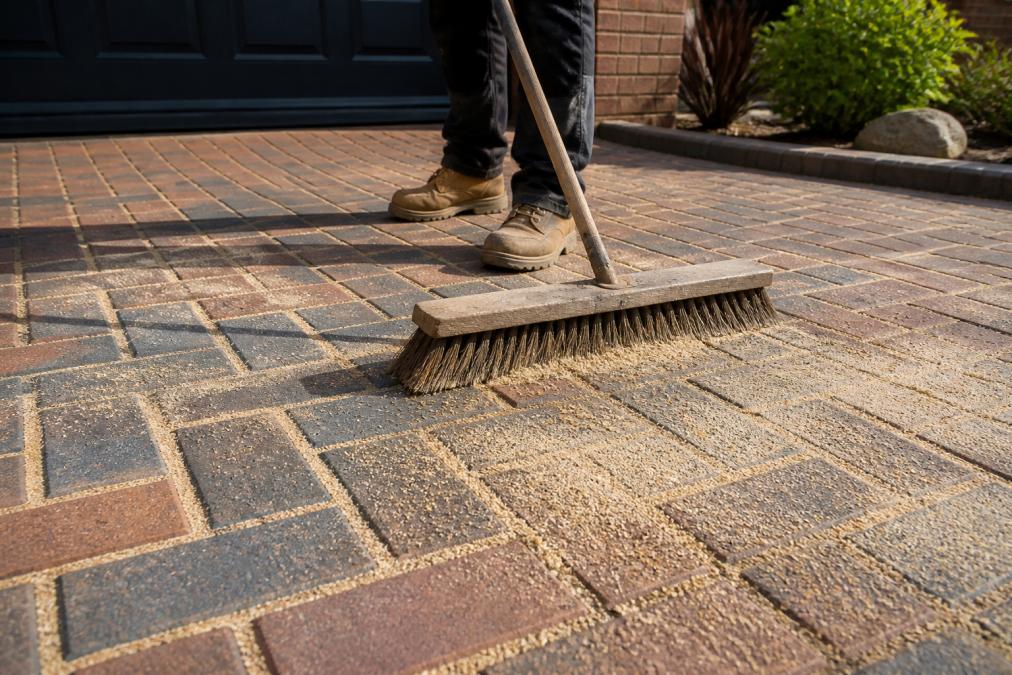
Block paving cleaning and re-sanding is the step most DIY jobs miss, and it's the reason so many drives look tired again within a season. Cleaning lifts the dirt and growth; re-sanding restores the joint structure that keeps blocks stable and firm.
Why Kiln-Dried Sand and Dry Weather Matter
Kiln-dried sand is moisture-free, which means it flows into the joints instead of clumping on the surface (paving.org.uk). It only works when the paving is genuinely dry, so a dry spell matters more than a free afternoon. Sweep it in with a soft broom, work it into the joints, and let the surface settle. Re-sanding is not a permanent weed-prevention guarantee, because regrowth depends on shade, moisture, drainage and what's growing nearby. It is, however, one of the most effective things you can do for a block-paved drive.
Tip 5: Clear the Area and Protect Plants, Pets and Drainage
Preparation takes twenty minutes and prevents most of the complaints that follow a bad clean. Move cars, bins and garden furniture, then think about what the water will carry with it.
- Cover or move pots, planters and garden furniture
- Keep pets and children indoors while work is underway
- Check where run-off will flow, and protect drains and watercourses
- Warn neighbours if overspray is likely near a shared boundary
- Check for cracked slabs, loose blocks or failing pointing before you start
If a surface is already damaged, cleaning won't fix it, and water can make existing problems more obvious. A quick walkover beforehand saves awkward conversations later.
Tip 6: Never Use a Turbo Nozzle on Delicate Surfaces
A turbo nozzle concentrates a rotating jet into a small area. On the right surface it strips stubborn dirt quickly. On the wrong one it etches, scars and strips joint sand in seconds.
Keep rotating nozzles away from porcelain, imprinted concrete, natural stone and any surface with a decorative finish. Even on durable concrete, nozzle choice and cleaning distance matter more than raw machine output. Remember that a pressure washer's maximum rating is not the pressure reaching the surface, and it's the pressure at the surface that decides whether damage occurs.
Tip 7: Work in Sections and Keep the Finish Even
Even results come from even working, not from working harder. Divide the driveway into manageable sections and finish each one before moving on. Overlap your passes slightly so you don't leave visible bands where one section meets the next.
Two things catch people out. First, working in direct sun can dry treatments and water too quickly, which affects how evenly the surface responds. Second, stopping halfway through a section leaves a tide mark that's difficult to blend in later. If the driveway is large, or the surface is a material you're not confident with, that's usually the point where a professional clean works out cheaper than a re-do.
Tip 8: Know the Driveway Cleaning Cost Factors Before You Book
Driveway cleaning cost factors vary far more than most quotes suggest, which is why a figure given over the phone without seeing the property is rarely accurate. Size is only the starting point.
- Total area and number of sections
- Surface material, age and condition
- Type and severity of contamination
- Access, parking and where water can drain
- Working height and any awkward edges
- Whether treatment, re-sanding or sealing is needed
- Time on site and equipment required
We don't quote blind. Send photographs and your postcode through WhatsApp and we'll give you a free, no-obligation quote based on what's actually there. That's also why we can't promise a completion time before seeing the property: weather, access, drying and treatments all affect the schedule.
Tip 9: Seal Only When the Surface and Weather Allow
Sealing can help protect a clean driveway from oil, water and dirt, but it is not automatically included, and it isn't suitable for every surface. Some porcelain and certain natural stones don't take a sealant well, and applying one to a damp or dirty surface traps moisture underneath (Inspection and Snagging of Finished Internal Works Using Natural Stone).
Only seal when the surface is clean, fully dry and the weather is settled. If sealing isn't right for your driveway, we'll say so rather than sell you something that won't help. That's the same approach behind our White Glove Standard: assess the surface, choose the right treatment, clean it properly, and protect the planting and lawns around it while we work. If you'd like a hand keeping on top of regrowth, our maintenance visits are designed to do exactly that.
Frequently Asked Questions
What is the best way to clean a block paved driveway?
Start by removing loose debris and surface moss with a stiff broom, then treat any algae or black spot before washing. Controlled pressure washing may suit durable block paving, but the pressure, nozzle and distance need adjusting to the surface. Once the paving is completely dry, kiln-dried sand can be swept back into the joints to stabilise the blocks. Re-sanding helps, but it is not a permanent weed-prevention guarantee, so expect some regrowth over time depending on shade and drainage.
Can I use a pressure washer on all types of driveways?
No. Durable concrete and block paving may cope well with controlled pressure washing, but natural stone, weathered surfaces and imprinted concrete can be marked or eroded by too much pressure or the wrong nozzle. Soft washing, which uses lower pressure with an appropriate treatment, may be more suitable for delicate or stained surfaces. The right choice depends on the material, its age, its condition and any previous treatments. A quick assessment usually prevents expensive mistakes.
How often should you have your driveway professionally cleaned?
It varies with your driveway's surroundings. A shaded driveway under trees in Bolton or Bury may grow algae and moss again within months, while a sunny, open surface can stay presentable far longer. Many homeowners book a clean every 12 to 18 months, with a lighter maintenance visit in between. Regrowth depends on moisture, drainage, orientation and nearby planting, so no fixed schedule suits every property. Photographs and a postcode are enough for a sensible recommendation.
Do I need to re-sand my driveway after cleaning?
Often, yes. Pressure washing and heavy rain both wash sand out of block paving joints, which lets blocks shift and gives weeds somewhere to root. Re-sanding with kiln-dried sand once the surface is fully dry restores stability and tidies the finish. It is worth checking joints after every deep clean. Re-sanding is not a permanent fix, and it should not be done on a damp driveway because the sand will not sweep in properly.
How do I prevent moss and weeds from returning to my driveway?
You cannot stop regrowth completely, but you can slow it down. Clear fallen leaves and debris regularly, keep drainage gullies free, and trim back plants that shade the surface. Treat organic growth when it first appears rather than waiting for it to spread. Re-sanding joints and, where suitable, sealing can also help. Shade, moisture and nearby trees all influence how quickly growth returns, so a maintenance visit is often more practical than expecting a one-off clean to last forever.