 how-to
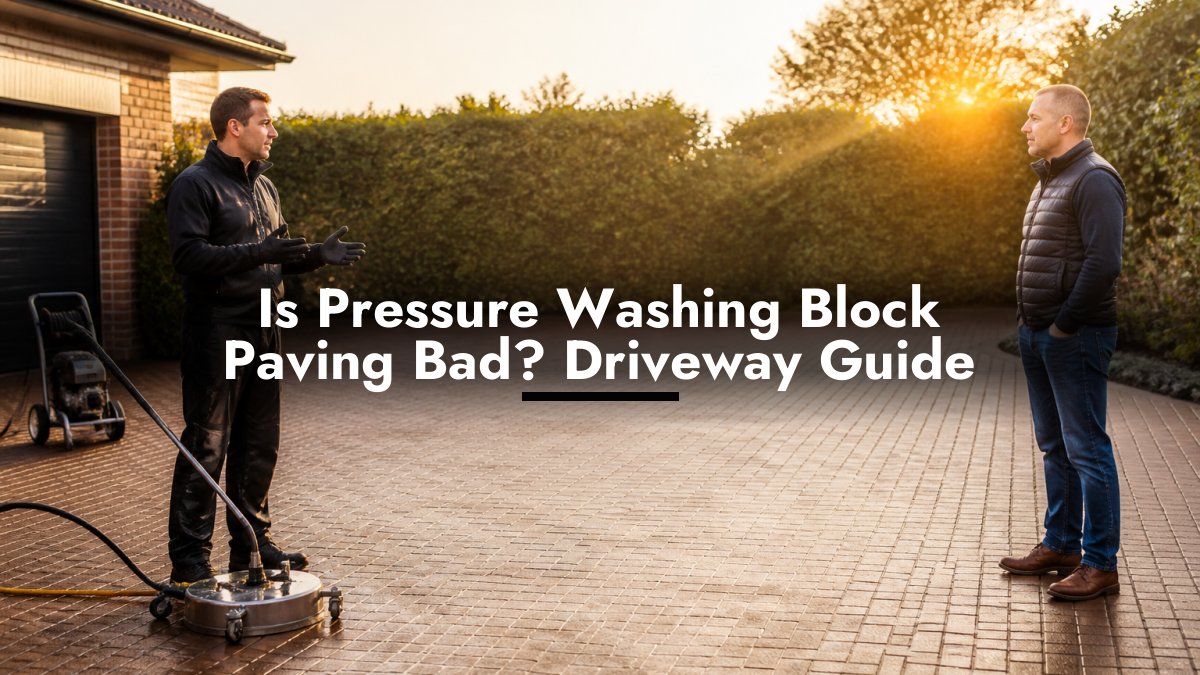
Is Pressure Washing Block Paving Bad? Driveway Guide
Table of Contents
- Is Pressure Washing Block Paving Bad for Your Driveway? The Short Answer
- How to Clean Block Paving Without Causing Damage
- What Pressure Washing Does to Block Paving Jointing Sand
- Re-Sanding Block Paving After Pressure Washing: What to Do
- How Often to Pressure Wash a Driveway
- Signs Your Block Paving Is Too Damaged for Pressure Washing
- When to Hire a Professional Exterior Cleaning Company
- Conclusion: Protecting Your Driveway for the Long Term
- Frequently Asked Questions
Last Updated: 6 October 2026
Is Pressure Washing Block Paving Bad for Your Driveway? The Short Answer
Pressure washing block paving is not automatically bad for your driveway. The damage comes from how it is done, not from the method itself. Too much pressure strips the jointing sand, loosens blocks and drives dirt deeper into the surface. Done properly, with the right nozzle, the right angle and the right pressure setting, it is a safe and effective way to clean block paving.
At Refresh Revive Exterior Cleaning, we clean driveways across Bolton and the wider North West every week. The pattern we see is consistent: most block paving damage we are called out to inspect was caused by a high-pressure lance held too close, not by pressure washing as a concept.
So if you are asking whether pressure washing block paving is bad for your driveway, the honest answer is: it depends entirely on technique. Below, we explain exactly what goes wrong, how to clean block paving safely, and when to call in a professional instead.
How to Clean Block Paving Without Causing Damage
The safest way to clean block paving is treatment-led cleaning first, followed by controlled low-pressure washing only where it is needed. This two-stage approach kills organic growth at the root and lifts dirt without disturbing the joints.
Most DIY damage happens because people reach straight for the pressure washer. That skips the step that actually does the work.
Treatment-Led Cleaning: The Safer First Step
Treatment-led cleaning means applying a suitable cleaning solution to the paving, letting it react, then rinsing. It targets the algae, moss and black spot that make block paving look tired.
- Apply the treatment evenly across the surface
- Allow the correct dwell time so it can work
- Agitate stubborn areas with a stiff brush
- Rinse with low pressure, working with the fall of the paving
This method is gentle on joints and highly effective on organic growth. It is also the approach we use as standard, because it protects the surface while still delivering a proper clean.
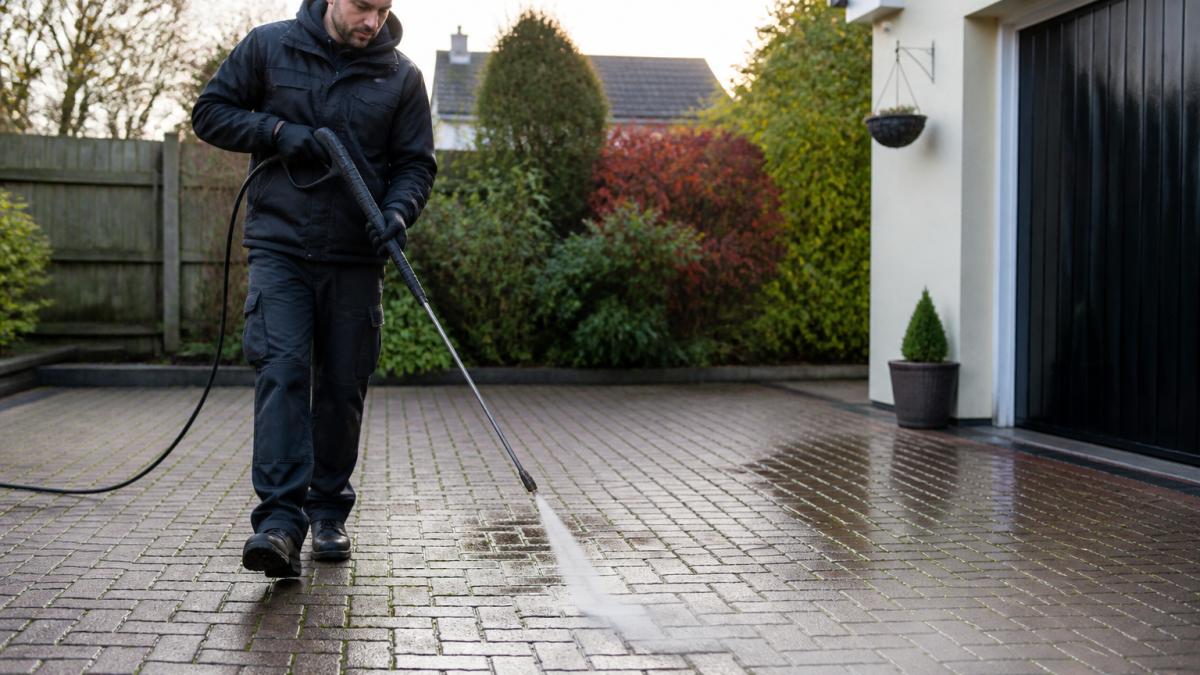
Controlled Pressure Washing Done Properly
If pressure washing is used, it must be controlled. That means a wider fan nozzle, a safe distance from the surface, and a steady, even pass rather than dwelling on one spot.
- Keep the wand moving at all times
- Hold the nozzle at a shallow angle, not straight down
- Never aim directly into open joints
- Work in sections and check as you go
The goal is to lift dirt off the surface, not to blast the joints out. A rotary surface cleaner attachment is generally safer than a bare lance because it spreads the pressure evenly.
What Pressure Washing Does to Block Paving Jointing Sand
Jointing sand is the fine kiln-dried sand brushed into the gaps between blocks. It locks the blocks together and stops them moving underfoot or under vehicle weight.
When pressure washing is too aggressive, that sand is the first thing to go. The joints open up. Blocks start to rock. Weeds and moss find it far easier to take hold in an open joint than a full one.
This is the single biggest reason people believe pressure washing block paving is bad for a driveway. In truth, it is not the washing that is the problem. It is the loss of jointing sand that follows a careless job.
The fix is straightforward: replace the sand after cleaning. More on that next.
Re-Sanding Block Paving After Pressure Washing: What to Do
Re-sanding block paving after pressure washing is essential if any jointing sand was lost. Without it, the joints stay open and the driveway will deteriorate.
Wait until the paving is completely dry. Then brush kiln-dried sand across the surface and work it into the joints with a stiff broom. Top up any low spots and repeat until the joints sit full and level.
- Clean and let the paving dry fully first
- Spread kiln-dried sand evenly across the area
- Brush it into the joints in several directions
- Top up and repeat until joints are full
- Consider a joint stabiliser or sealer to lock the sand in
A stabilising sealer is worth considering on driveways that lose sand regularly (Fixing kiln dried sand with pva - Page 2). It helps hold the jointing sand in place and slows down the return of moss and weeds.
How Often to Pressure Wash a Driveway
Most block paving driveways only need a proper clean once every 12 to 24 months. Cleaning more often than that usually means the underlying problem, such as poor drainage or shade, has not been addressed.
How often to pressure wash a driveway depends on a few things:
- How much shade the driveway gets
- Whether it sits under trees
- How much traffic it takes
- Whether it has been sealed
A north-facing driveway under a tree will grow algae far faster than a sunny, open one. In those cases, a maintenance visit once a year keeps on top of it without harsh cleaning.
If you cleaned your driveway last summer and the moss came back within weeks, the growth was never fully removed. Surface cleaning alone rarely solves that. Killing the growth at the root, then protecting the joints, is what makes the result last.
Signs Your Block Paving Is Too Damaged for Pressure Washing
Some driveways should not be pressure washed at all until repairs are done. Pushing water into an already failing surface makes things worse.
Watch for these signs:
- Blocks that rock or sink when you step on them
- Large areas of missing jointing sand
- Cracks running through multiple blocks
- Pooling water that never drains
- Soft or crumbling edges near the kerb
If you spot any of these, the paving needs repair or re-laying before cleaning. Cleaning a failing driveway just hides the problem for a few weeks.
When to Hire a Professional Exterior Cleaning Company
Hiring a professional makes sense when you want the job done without risking the joints, or when the driveway has not been cleaned in years. A trained team knows which surface needs which method.
We treat every surface on its own terms. Block paving gets treatment-led cleaning and controlled pressure, not a blanket blast. Roofs get soft washing and moss removal without aggressive high-pressure washing that strips granules. Gutters are cleared using high-reach vacuum equipment with camera inspection, so we can see exactly what we are dealing with.
For commercial sites across Bolton, Greater Manchester and Lancashire, we work to RAMS and COSHH standards, which matters for facilities managers, schools, care homes and retail premises that need documented, insured work.
For homeowners in areas like Hale, Wilmslow and Prestwich, the appeal is simpler: a driveway that looks properly restored, with the joints protected so the result lasts.
If you are searching for driveway cleaning near me in Bolton, the key question is not how much pressure a company uses. It is whether they understand what the surface needs.
Conclusion: Protecting Your Driveway for the Long Term
Block paving is durable, but it is not indestructible. The difference between a driveway that lasts decades and one that shifts and sinks comes down to how it is cleaned and maintained.
Pressure washing block paving is not bad for your driveway when it is done with care. Strip the jointing sand with a careless blast, though, and you speed up every problem that follows.
If you would like your driveway cleaned properly and protected for the long term, Refresh Revive Exterior Cleaning can help. We offer treatment-led cleaning, controlled pressure washing, re-sanding and surface sealing across Bolton and the North West. Send us a few photographs of your driveway and we will assess it and give you a free, no-obligation quote.
Frequently Asked Questions
Can you pressure wash block paving without damaging it?
Yes, but only with the right technique. Use a fan nozzle rather than a pencil jet, keep the wand moving, and work at a shallow angle to avoid lifting blocks or blasting out jointing sand. Rotary surface cleaners are safer than freehand lances because they distribute pressure evenly. Even then, some jointing sand will be lost, so plan to re-sand afterwards. If your paving is already loose, cracked, or has wide joints, treatment-led cleaning or soft washing is the better option.
Does pressure washing remove the sand between paving blocks?
It usually does, at least partially. Jointing sand sits loosely between blocks and is easily displaced by a direct jet. The finer the sand and the higher the pressure, the more you lose. This matters because jointing sand locks the blocks together and stops weeds and ants from getting a foothold. After any pressure washing, you should top up the joints with kiln-dried sand and compact it properly. Skipping this step is why many driveways look worse a few months later.
Should you re-sand block paving after pressure washing?
Yes, in almost every case. Wait until the paving is completely dry, usually 24 to 48 hours in good weather. Brush kiln-dried sand into the joints, working diagonally across the pattern, then compact with a vibrating plate. Top up any joints that settle low and brush off the excess. Re-sanding protects the blocks, stabilises the surface, and makes future weed growth far less likely. It is the step most DIY jobs miss and the reason results do not last.
Is soft washing safer than pressure washing for block paving?
For most block paving, yes. Soft washing uses low pressure and a treatment solution to kill algae, moss, and lichen at the root rather than blasting them off the surface. It avoids displacing jointing sand and does not disturb the bedding layer. The trade-off is that it takes longer and results appear over a few days as the growth dies back. A combination approach works well: soft wash first, then a light controlled rinse, then re-sand.