 how-to
How to Remove Black Spots from Patio Stones
Table of Contents
- What Actually Causes Black Spots on Patio Stones?
- Which Cleaning Method Suits Your Patio Surface?
- Choosing a Patio Black Spot Remover for Your Stone
- How to Clean Indian Sandstone Without Causing Damage
- Step-by-Step: Cleaning Black Spots Yourself
- Common Mistakes to Avoid When Treating Black Spots
- Preventing Black Spots from Returning
- When to Call a Professional Patio Cleaning Service in Bolton
- Frequently Asked Questions
**
What Actually Causes Black Spots on Patio Stones?
Learning how to remove black spots from patio stones starts with understanding what you are actually dealing with. Those dark speckles are usually lichen, a combination of algae and fungus that bonds tightly to stone surfaces (britannica.com). In Bolton and across the North West, our damp climate gives it ideal conditions to thrive.
Lichen differs from ordinary green algae. Algae sits on the surface as a slippery film. Lichen anchors itself into the stone's pores, which is why a quick rinse rarely shifts it.
Black spot also appears on Indian sandstone, concrete paving and porcelain. Shaded patios, north-facing surfaces and areas beneath trees tend to develop it fastest, because moisture lingers there.
Which Cleaning Method Suits Your Patio Surface?
The right method depends on the material, its age and how deep the growth has taken hold. There is no single approach that suits every patio, and anyone who tells you otherwise has not looked closely at your stone.
Here is how the main options compare:
| Method | Best For | Main Limitation |
|---|---|---|
| Pressure washing | Durable concrete and paving | Can damage soft or aged stone |
| Hot-water cleaning | Grease and organic build-up | Still needs surface assessment |
| Soft washing | Sandstone, render, delicate stone | Slower, needs dwell time |
| Manual brushing | Small areas, light growth | Labour-intensive, surface only |
Controlled pressure washing may suit strong concrete. On softer natural stone, lower-pressure treatment with an appropriate product is often the better route. The method is chosen according to the surface, not the other way around.
Pressure Washing: When It Works and When to Avoid It
Pressure washing works well on durable, well-laid concrete and some paving. It lifts surface growth and grime quickly when pressure, flow, nozzle choice and distance are matched to the material.
Where it goes wrong is on aged or porous stone. Too much pressure can strip pointing, open up the surface and leave it more receptive to regrowth (Publications). On Indian sandstone, blasting can also loosen the natural layers.
Soft Washing and Low-Pressure Treatments
Soft washing uses lower pressure with an appropriate treatment to tackle algae, moss and lichen at the root. It is often the more suitable option for delicate surfaces where high pressure carries too much risk.
The trade-off is time. Soft washing relies on the treatment doing the work, so it needs dwell time before rinsing. For heavily shaded patios in places like Horwich or Westhoughton, that slower approach usually gives a more even result than pressure alone.
Choosing a Patio Black Spot Remover for Your Stone
A patio black spot remover is a treatment product designed to break down lichen and algae rather than simply blast them away. The key word is "appropriate", what suits concrete may be too harsh for sandstone.
When comparing products, check what the manufacturer states about suitable surfaces. Some are formulated for hard paving only. Others are intended for natural stone. Always read the label and safety data sheet before use, and follow the stated guidance on dilution and application.
Never mix products together, and never guess at ratios. If a label does not cover your surface type, treat that as a stop sign rather than a challenge.
How to Clean Indian Sandstone Without Causing Damage
Cleaning Indian sandstone calls for a gentler hand than most people expect. This stone is porous, layered and variable, so aggressive pressure can pit the surface and strip its colour.
Low-pressure treatment is usually the safer starting point. A suitable product is applied, allowed to dwell, then rinsed at reduced pressure. Stubborn areas may need a second, patient pass rather than more force.
Avoid acidic products on sandstone unless the manufacturer specifically confirms suitability. Test any treatment on a small, inconspicuous area first, and keep run-off away from plants, lawns and drainage where possible.
HSE guidance on safe use of cleaning chemicals is worth reading before handling any treatment product, particularly around pets, plants and watercourses.
Step-by-Step: Cleaning Black Spots Yourself
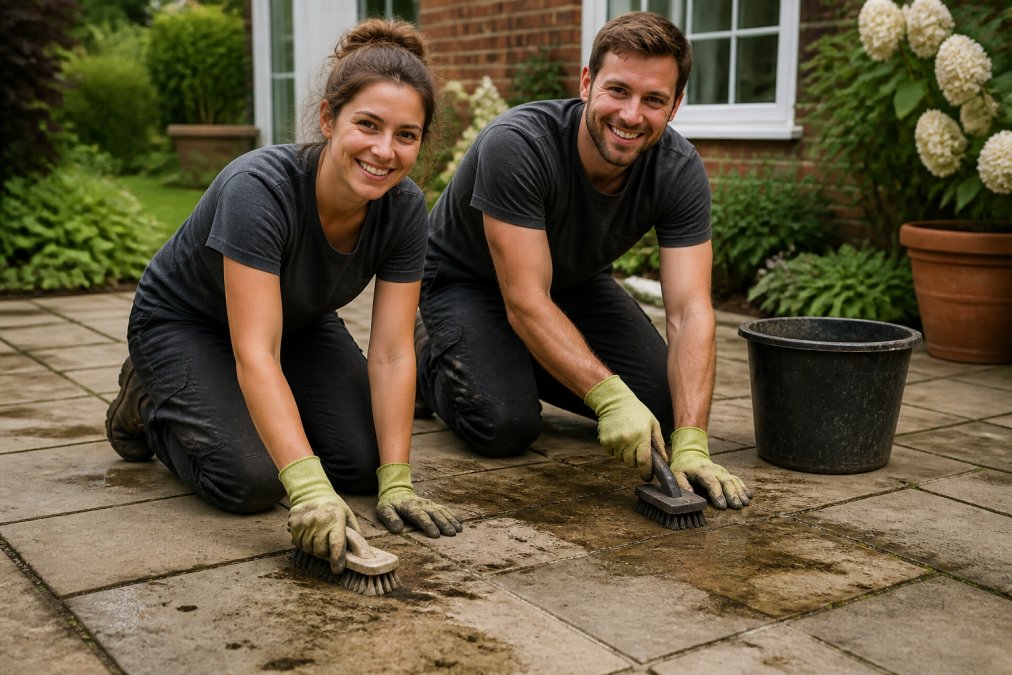
You can tackle light to moderate black spot yourself with patience and the right sequence. Work on a dry day, and do not rush the dwell time.
What you'll need:
- A stiff brush (not wire)
- A suitable black spot treatment for your stone type
- A garden sprayer or watering can
- Clean water for rinsing
- Gloves and eye protection
Steps:
- Clear the patio of furniture, pots and toys.
- Sweep away loose debris and leaves.
- Test the treatment on a small hidden area first.
- Apply the product evenly across affected stone, following the label.
- Leave it to dwell for the stated time.
- Agitate lightly with a stiff brush on stubborn patches.
- Rinse thoroughly with clean water.
- Repeat after a few days if growth persists.
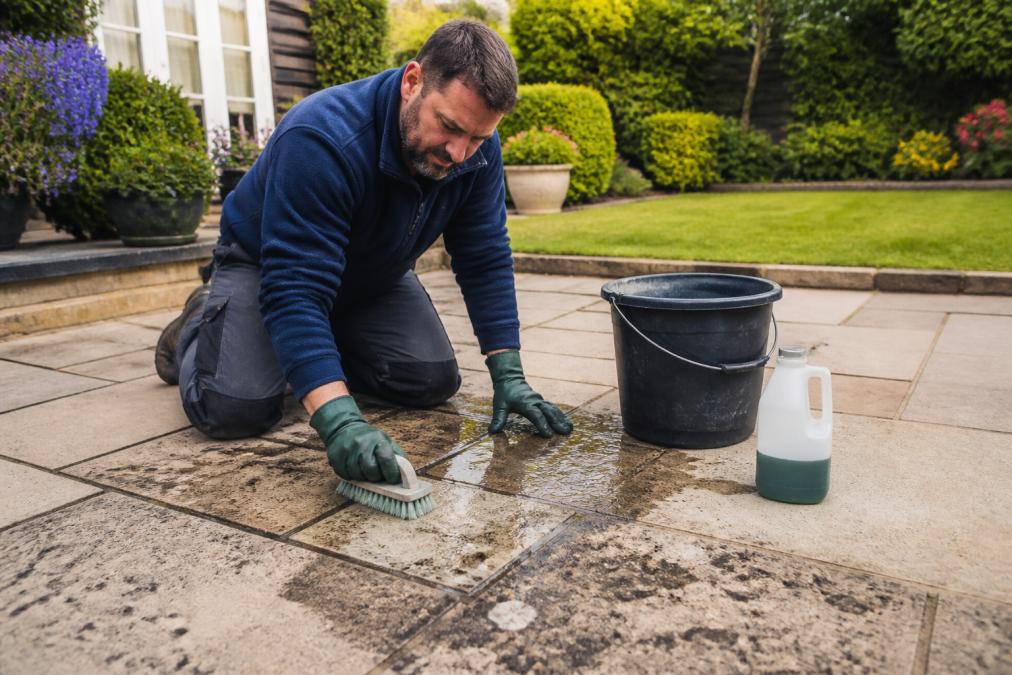
Expect improvement rather than a perfect first pass. Deep-set lichen on porous stone often needs more than one treatment cycle.
Common Mistakes to Avoid When Treating Black Spots
The biggest mistake is reaching for the most powerful tool available. More pressure and stronger products do not equal better results on natural stone.
Other common errors:
- Applying treatment to a wet surface, which dilutes it
- Skipping the test patch and staining the whole patio
- Using a wire brush that scratches the stone
- Letting run-off reach plants, ponds or drains
- Expecting one application to clear years of growth
A common mistake is treating the symptom and ignoring the cause. If the patio stays damp and shaded, black spot will return regardless of how well you clean it.
Preventing Black Spots from Returning
Prevention comes down to managing moisture. Growth needs damp, shaded conditions, so anything that helps the surface dry faster reduces the odds of regrowth.
Practical steps include:
- Sweeping leaves and debris regularly
- Trimming back overhanging shrubs and branches
- Improving drainage where water pools
- Re-sanding block paving joints once dry, where appropriate
- Booking periodic maintenance rather than waiting for a full outbreak
Re-sanding is not a permanent weed or growth guarantee, and sealing is not automatically suitable for every surface. Regrowth depends on shade, moisture, weather, nearby trees and how the patio faces, so results will vary from one property to the next.
When to Call a Professional Patio Cleaning Service in Bolton
Some patios are simply too large, too delicate or too far gone for a DIY approach. If growth has spread across a wide area, or your stone is aged and fragile, professional patio cleaning in Bolton is often the sensible call.
That is where Refresh Revive Exterior Cleaning comes in. We assess the surface first, choose the treatment that suits it and clean it properly, rather than applying one method to everything. Our low-pressure approach helps protect your planting, lawns and surrounding property, and we document before and after so you can see exactly what changed.
For patios in Bury, Farnworth, Little Lever, Kearsley and the wider Greater Manchester area, we work around the surface rather than against it.
Cost depends on area size, material, condition, contamination, access, drainage and whether treatment or re-sanding is needed. We provide free, no-obligation quotes so you know where you stand before any work begins.
Frequently Asked Questions
What actually causes black spots on patio stones?
Black spots are usually lichen, algae or a mix of organic growth and airborne deposits that settle into the stone's surface. They thrive in damp, shaded conditions common in Bolton and across the North West. Once established, they can be stubborn because the growth anchors into the pores of natural stone. Different stone types attract different growth, so identifying the cause helps you choose the right treatment.
Can I remove black spots from my patio with a pressure washer?
A pressure washer can lift some surface growth from durable stone, but it is not always the right answer. Too much pressure on softer materials like Indian sandstone can strip the surface and leave it more vulnerable to regrowth. Adjusting pressure, flow and nozzle choice matters. For deeper black spots, a low-pressure treatment may be more suitable than blasting the surface at close range.
Why do black spots return after cleaning?
Regrowth depends on shade, moisture, drainage, weather and nearby trees. If those conditions stay the same, spots can return over time. Cleaning removes the growth, but it does not change the environment. A maintenance routine or periodic treatment helps slow regrowth. Some surfaces benefit from re-sanding or sealing after cleaning, but this is not suitable for every patio and should be assessed first.
Does Indian sandstone need special care when removing black spots?
Indian sandstone is a natural material with varying porosity, so it can be more sensitive to aggressive cleaning than concrete or porcelain. High pressure or harsh chemicals may dull the surface or cause uneven colour. A controlled low-pressure approach with a suitable treatment is often more appropriate. Always test a small area first and follow the manufacturer's guidance for any product you use.