 how-to
Does Render Cleaning Damage Windows? What Bolton Owners Need to Know
Table of Contents
- The Real Risk: How Render Cleaning Can Damage Windows
- Soft Washing Render vs Pressure Washing: Which Method Protects Windows?
- How to Protect Windows During Exterior Cleaning
- Types of Window Damage That Can Occur During Render Cleaning
- Preventative Measures Before and After Render Cleaning
- Refresh Revive Exterior Cleaning's Surface-Specific Approach
- What Affects Cost, Timescale and Results
- Frequently Asked Questions
Last Updated: September 15, 2026
The Real Risk: How Render Cleaning Can Damage Windows
Yes, render cleaning can damage windows, but only when the wrong method meets the wrong surface. High-pressure water aimed at rendered walls drives water into window seals and can abrade glass edges, while harsh chemical treatments left to dwell can stain frames and etch surrounding glass. At Refresh Revive Exterior Cleaning, we assess the render, the window type and the surrounding surfaces before choosing a method. That assessment is what separates a clean wall from a repair bill.
The concern is fair. In Bolton and across Greater Manchester, many homes have rendered elevations sitting directly above uPVC or aluminium windows, and the two surfaces need very different treatment. Water that is fine for a concrete render panel can be damaging at the frame.
Here is the key point most guides miss: it is rarely the water alone that causes damage. It is pressure, dwell time, chemical strength and technique combined.
Glass Etching and Surface Damage
Glass etching is permanent surface damage caused by abrasive particles or aggressive chemicals contacting the glass. Two mechanisms cause it during render cleaning.
The first is airborne grit. When pressure washing lifts dirt, sand or render fragments off a wall, those particles become a fine spray. At high velocity, they pit the glass surface and leave a dull, cloudy patch that no amount of wiping removes.
The second is chemical. Some render treatments are alkaline or acidic by design. If overspray lands on glass and dries in the sun, the residue can leave a permanent bloom. This is why we keep treatments off glass, or rinse it promptly if contact occurs.
Frame and Seal Failure
Window frames rely on seals to keep water out of the wall cavity and the glazing unit. High-pressure water directed at the junction between frame and render can force water past those seals.
Once moisture gets behind a seal, the consequences show up later: misted double glazing, damp patches on internal plaster, or a failed unit that needs replacing. On older properties around Horwich and Westhoughton, where frames may already be weathered, the margin for error is smaller.
The fix is not complicated. Keep pressure low, keep the angle away from the frame, and treat the window surround as a boundary rather than a target.
Soft Washing Render vs Pressure Washing: Which Method Protects Windows?
Soft washing is generally the more suitable method for render near windows, because it cleans through a low-pressure application and an appropriate treatment rather than force. Pressure washing can be appropriate on some durable render types, but it demands tighter control of pressure, angle and distance.
The difference comes down to how each method removes contamination. Soft washing lets the treatment do the work, breaking down algae, moss and lichen over a dwell period, then rinsing at low pressure. Pressure washing relies on kinetic energy to blast contamination away.
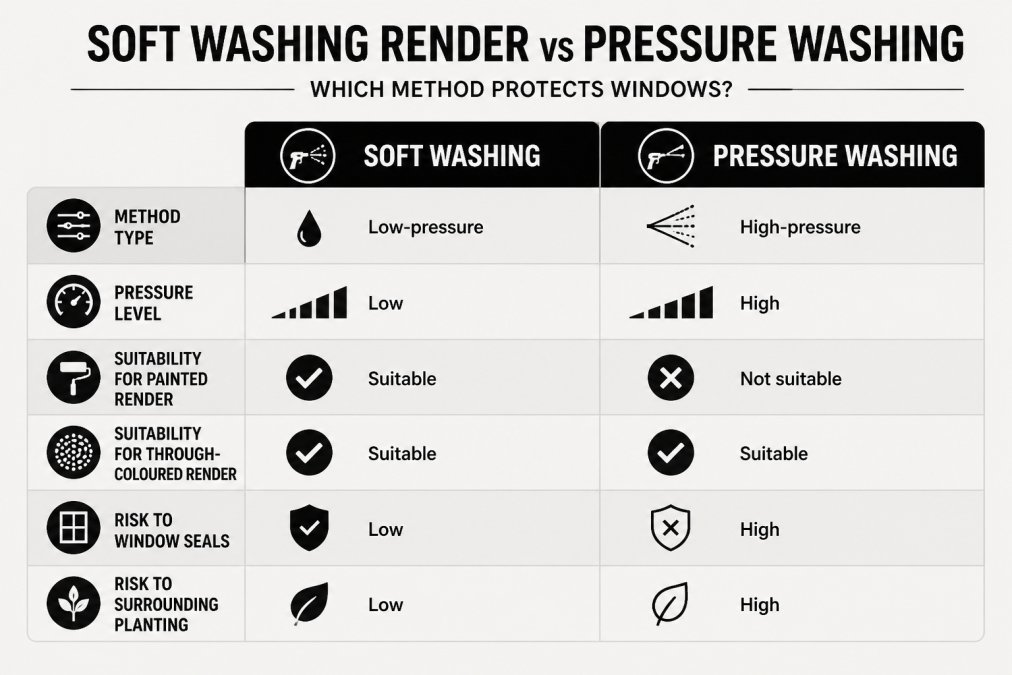
For most rendered homes in Bolton with standard uPVC windows, soft washing helps reduce the risk to glass, frames and seals. Pressure washing is not automatically wrong, but it is not the default for render either.
A common mistake is assuming that because a driveway can take high pressure, a rendered wall can too. Rendered surfaces are often softer and more porous than concrete or block paving. What works on one surface can mark another.
How to Protect Windows During Exterior Cleaning
Protecting windows during exterior cleaning comes down to four controls: method selection, pressure and angle, chemical management, and a rinse-down routine. Each one reduces a specific risk.
Here is the practical sequence we follow on render jobs:
- Confirm the render type and window frame material before starting
- Cover or mask windows where the method warrants it
- Set pressure and nozzle to suit the render, not the machine's maximum
- Keep the spray angle downward and away from the frame-render junction
- Apply treatments at the correct dilution and never let them dry on glass
- Rinse glass and frames promptly if any overspray occurs
- Check the window surrounds and seals after the clean
The angle matters more than most people realise. Water fired upward at the underside of a frame finds gaps that downward water never reaches.
Working from the ground with water-fed poles, rather than leaning ladders against freshly cleaned render, also reduces the chance of accidental contact damage.
Types of Window Damage That Can Occur During Render Cleaning
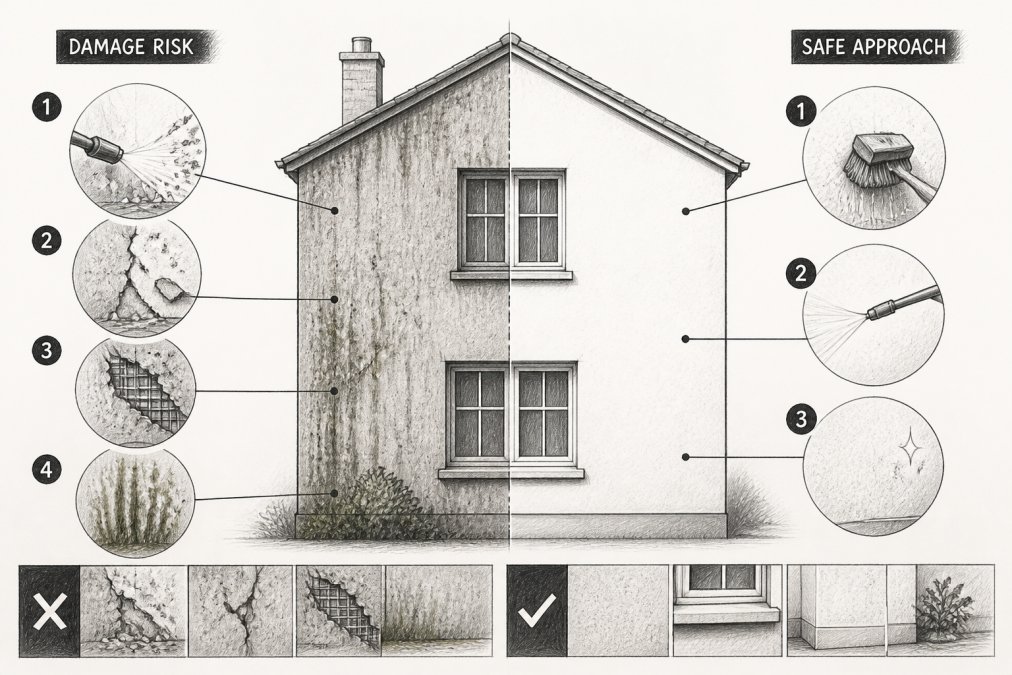
Window damage during render cleaning falls into four broad categories, and each has a different cause. Knowing them helps you spot a problem early.
Etched or bloomed glass. Caused by abrasive grit or dried chemical residue. Often permanent if left untreated.
Damaged or discoloured frames. Caused by aggressive chemicals reacting with uPVC or painted timber, or by physical abrasion from a nozzle held too close.
Failed seals and misted units. Caused by water forced past seals at high pressure, leading to moisture inside the glazing unit.
Scratched glass. Caused by grit trapped on a cloth or brush during the rinse-down, or by contact with equipment.
Not every mark is damage. Some residue wipes away with a clean cloth once dry. The genuine problems are the ones that remain after a proper rinse and dry.
Preventative Measures Before and After Render Cleaning
Prevention starts before a single drop of water hits the wall. A short pre-check saves a lot of trouble later.
Before the clean:
- Note the render type: painted, through-coloured, silicone, acrylic or traditional sand and cement
- Check window frames for existing cracks, failed seals or loose beading
- Identify plants, lawns and drainage runs that need protecting
- Confirm access and working height
After the clean:
- Inspect window seals and frames once surfaces are dry
- Check for any residue on glass and rinse if needed
- Review drainage points for debris washed down during the clean
- Plan a maintenance interval if regrowth is likely
Regrowth depends on shade, moisture, drainage, weather, nearby trees and the orientation of the wall. A north-facing rendered wall under trees will need attention sooner than a sunlit south-facing one. No treatment prevents regrowth permanently, and any company promising that is overstating what is possible.
Refresh Revive Exterior Cleaning's Surface-Specific Approach
Refresh Revive Exterior Cleaning uses a surface-specific approach on every render job. We assess the surface, choose the right treatment and clean it properly, rather than applying one method to every wall.
That means looking at the render type, the window frames, the surrounding planting and the access before quoting. Soft washing is often the more suitable route for render near windows, but the decision is made on site, not from a template.
Our White Glove Standard™ covers the details that protect your property: controlled low-pressure application on render, protection for planting and lawns, and before-and-after documentation so you can see exactly what changed. We are fully insured, and every quote is free with no obligation.
Regular window cleaning is normally offered every four weeks, and glass, frames and sills are included where applicable. If render cleaning is booked alongside window cleaning, we schedule the work so windows are checked after the render has been treated.
For homeowners in Bolton, Bury, Farnworth and the surrounding areas, this joined-up approach avoids the common situation where a wall is cleaned and the windows are left worse off.
What Affects Cost, Timescale and Results
Render cleaning pricing depends on several factors, and any figure quoted without seeing the property is a guess.
| Factor | Why It Matters | Typical Impact |
|---|---|---|
| Wall area and height | More surface and access equipment needed | Higher cost, longer job |
| Render type and condition | Delicate or damaged render needs gentler methods | Method changes, more care |
| Contamination level | Heavy algae or moss needs longer dwell time | Longer job |
| Window count and type | More windows means more protection and checking | More time on site |
| Access and drainage | Tight access or poor drainage slows work | Longer job |
| Treatment and re-treatment | Biocide or repeat visits where regrowth is heavy | Added cost |
| Time of year and weather | Rain and wind affect scheduling and drying | Possible rescheduling |
We do not quote a completion time before assessing the property. Weather, access, drying and treatments all affect the schedule, and it is better to be honest about that than to promise a slot we cannot hold.
Results are similarly variable. Most render responds well to a low-pressure clean and an appropriate treatment. Some staining will not lift, because it comes from weathering, rust, mineral deposits or a defect in the render itself. We will tell you that before we start, not after.
Frequently Asked Questions
Can pressure washing damage window seals?
Yes, high-pressure water directed at window seals can force water past the seal and into the frame or wall cavity. This may lead to damp, fogging between double-glazed panes or gradual deterioration of the seal itself. The risk increases when the nozzle is held close to the frame or angled upward. Controlled low-pressure methods, such as soft washing, help reduce this risk because the water reaches the surface at a gentler rate. A surface-specific approach matters more than the machine's maximum output.
Is soft washing safe for glass and UPVC frames?
Soft washing uses lower pressure and an appropriate treatment to tackle algae, moss and lichen on render. When applied correctly, the treatment is directed at the render rather than the glass, and windows are rinsed promptly afterward. This helps reduce the risk of streaking or residue. UPVC frames are generally durable, but any cleaning method should be chosen according to the frame's age and condition. Rinsing glass and frames after render cleaning helps prevent dried residue from becoming difficult to remove.
How do professionals protect windows during render cleaning?
Professionals typically pre-wet glass and frames before starting, which helps dilute any treatment that drifts onto them. They control the direction and distance of application, keeping the nozzle at a suitable angle to the render. After cleaning, windows are rinsed thoroughly with clean water. Some also use masking or sheeting on delicate surfaces nearby. The exact approach depends on the render type, access and the products being used. Following the manufacturer's label and safety data sheet is essential.
Should I clean my windows after having my render cleaned?
Yes, cleaning windows after render cleaning is good practice. Even with careful protection, some residue or water spots may remain on the glass. A pure-water window clean helps provide a clear, streak-free finish without detergent residue. Glass, frames and sills are included where applicable. Regular window cleaning is normally offered every four weeks, which helps keep the whole exterior looking consistent. If you have just had render cleaned, booking a window clean shortly afterward makes sense.